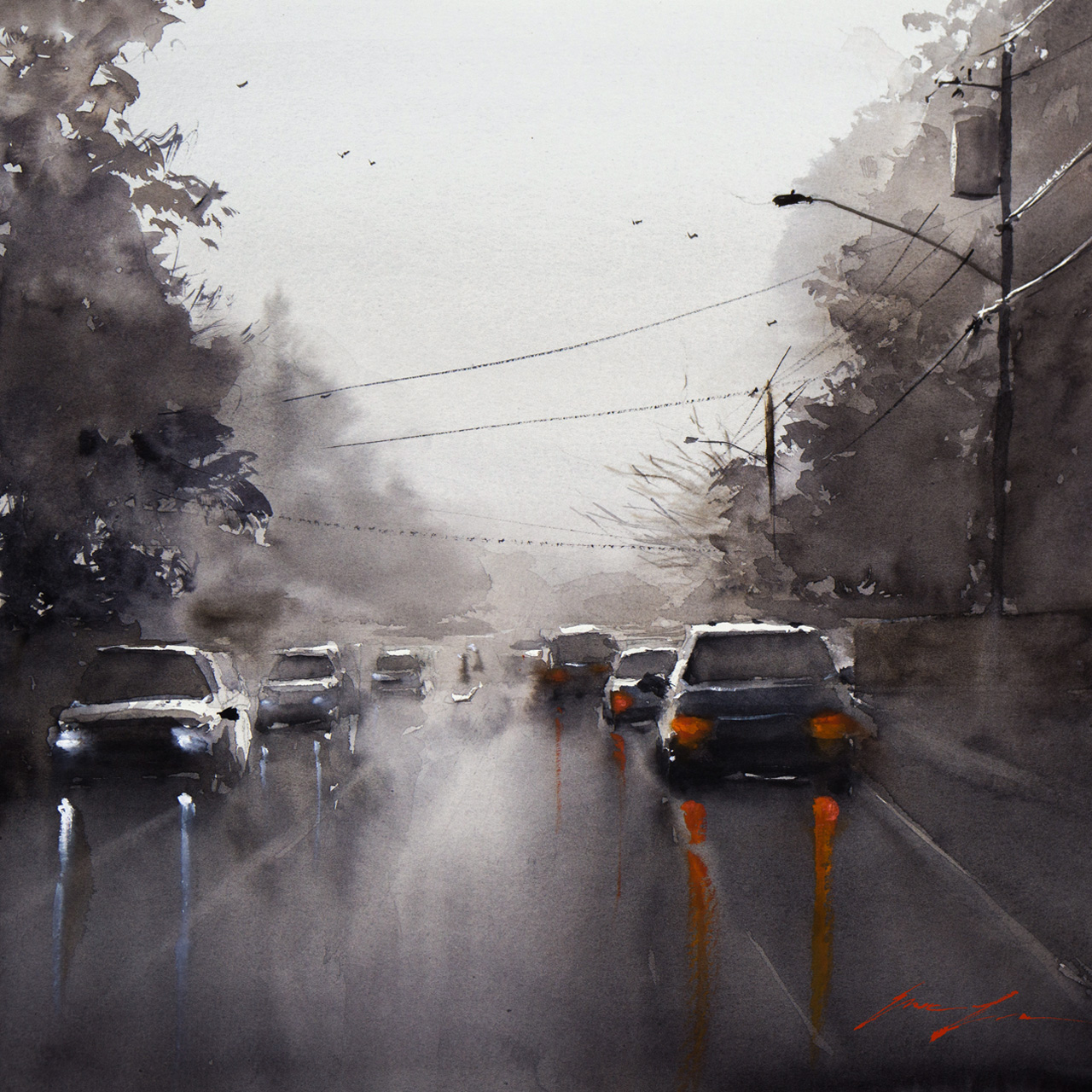

One of the problem I often see in an unsuccessful painting is incorrect scale. A believable scale is essential especially when you are painting a scenery with figures and man made objects. Sometime I see paintings with cars that's way too small compares to the figure next to it, or a building that looks like 4 stories tall but in reality it was suppose to be 10 stories. In this case, drawing is very important to get the right scale and placement. When you are drawing, go through the following steps to get an accurate scale:

1. Find a scale reference
In most cases, a person is a perfect scale reference, because that's what we see everyday. For most of the cityscape, you can measure almost anything with the size of a figure. Why? because city is build by man, for the size of an average man. If in your painting reference there's no figure, then find something that's related to a figure: handrail, trash can, or car. You can really get close and detail when doing a figure. A figure is typically about 7 and 1/2 head length. So from a head length to a figure, and from a figure to the surrounding. Everything is relative to another in scale.
Measure and compare
Now that you have a scale reference, start measuring things you draw by it. In this simple drawing, it shows the scale of the car relative to the figure. Most car is a bit shorter than an average person's shoulder level. You can double check that scale relationship next time when you are about to enter a car. Of course, there are different type of cars with different height level, a mini van can be as tall as a person while a moving truck can be 2+ people tall. But what ever you have in your scene, having a scale reference will enable you to measure just about everything. I also eyeball the height of the traffic light pole since I have a pretty good idea how much taller it should be now that I have a basic scale reference of a figure and a car.

Checking the scale in depth
It is likely that your scenery will have depth. I won't go into the importance of perspective, but it is important to know to measure your scale in different depth level. In a typical street scene, the horizon is at the head of the figure since it's at your eye level. The figures in the distance will become smaller and shorter while sharing the same eye level. This little drawing shows how the same figure looks in different depth level. And we can use it as the scale reference for the car at that depth.
It might feel a bit tedious to check your scale for everything at first. But as you do more drawings/paintings, you will be able to pick up the scale relationship much faster. Next week I will continue to talk about scale and how to create drama in your painting by playing with scale.